
Part II: Be the Captain of Your Own Score - Navigating the CDP Scoring Iceberg
CDP Scoring Part II – Below the Surface
July 2026
By Colton & Brittany
CDP scores may appear simple from the outside, but the underlying mechanics are complex, and even experienced CDP responders may not fully understand how they work.
Some sustainability professionals face significant pressure to improve or maintain their score, but the letter grade is only one signal. The broader purpose is to use disclosure to drive meaningful environmental progress and identify where stronger practices, better evidence, and more mature systems are needed.
Regardless of the driver—internal or external—it helps to understand the rubric behind the score. To make those mechanics easier to see, PSC developed the CDP Scoring Iceberg. In Part I, we focused on the visible elements above the waterline, including questionnaire structure, scoring levels, point assignments, and how scores are assigned and updated. In this standalone Part II, we move below the waterline to examine the less visible mechanics that often determine whether a company advances, stalls, or falls short of the credit it expected.
Scope note: This blog and the CDP Scoring Iceberg focus specifically on CDP’s corporate reporting and scoring framework, not disclosures for cities, states, or regions.
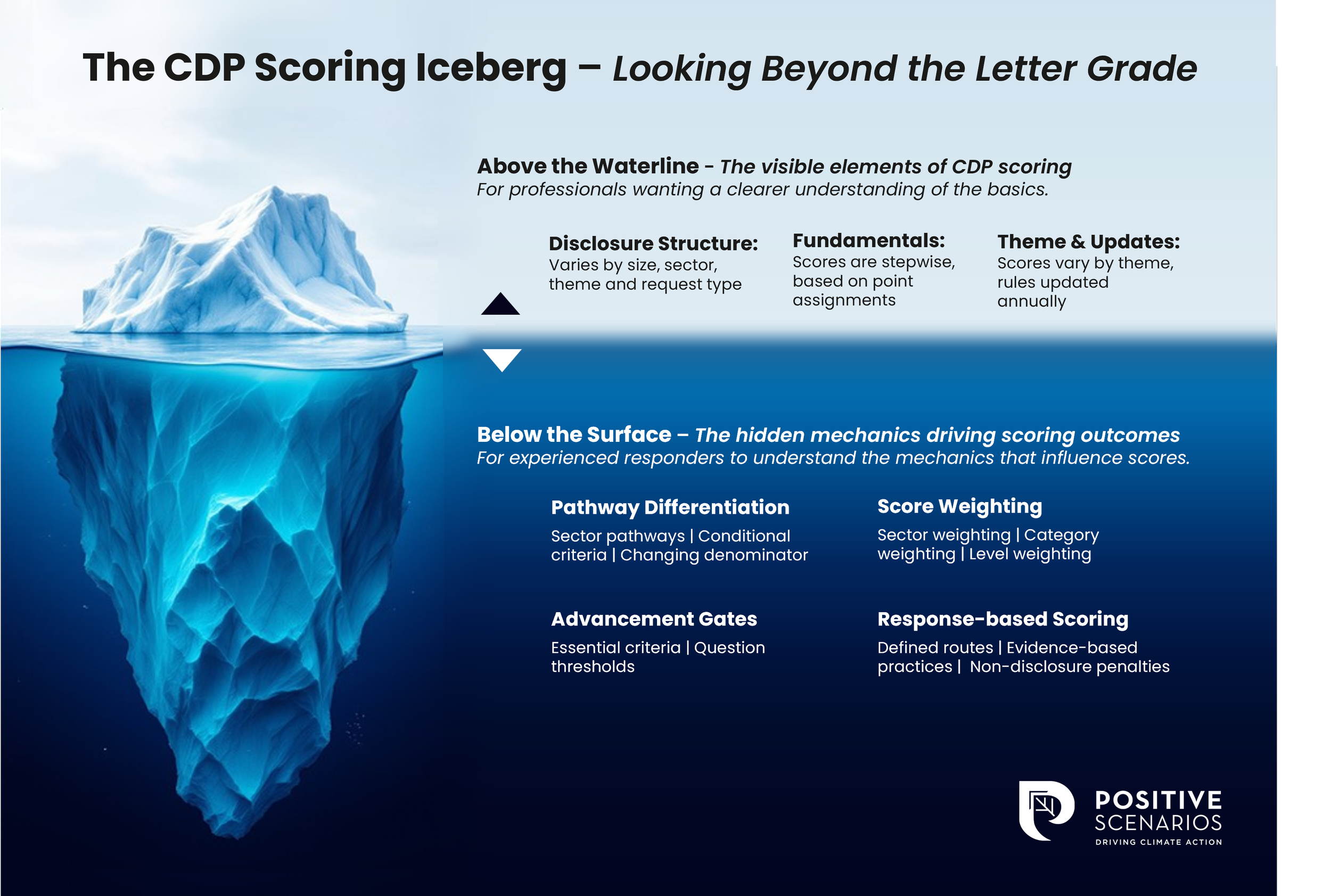
Below the surface is where CDP scoring becomes more technical and less transparent. Using the Iceberg as a guide, PSC groups these technical mechanics into four categories: pathway differentiation, advancement gates, score weighting, and response-based scoring.
Pathway Differentiation – why companies see different scoring paths
CDP does not apply a one-size-fits-all approach to scoring disclosures. Instead, a company’s questionnaire and scoring pathway varies based on sector, relevance, and their real-time responses. As a result, two companies may not answer the same set of questions – or be scored against the same denominator – even within the same disclosure theme.
Sector pathways – Companies in certain sectors receive additional questions or modified scoring expectations because their environmental impacts are more material or because they have significant influence across value chains.
For example, companies with forest-risk commodity exposure may be asked about traceability, certification, supplier engagement, and deforestation, while financial services companies may be asked about financed emissions, portfolio exposure, client engagement, and climate-related financing policies.Conditional criteria – Many CDP questions contain conditional logic. One response may trigger a small number of follow-up datapoints, while another may open a larger set of requirements.
For example, indicating that a climate-related risk is substantive can trigger follow-up questions about the risk type, time horizon, financial impact, mitigation response, and cost of response. If the risk is not substantive, fewer details are requested.
Changing denominator – Because of sector pathways and conditional questions, CDP scoring is not based on a fixed denominator. Two companies can answer different sets of applicable questions, which means both the numerator and denominator can shift depending on sector, relevance, and response choices.
For example, a company that reports forest-risk commodity exposure may be scored on additional forests-related criteria that would not apply to a company without those commodities.
Advancement Gates - what can block score advancement
CDP includes criteria that can limit whether a company advances from one scoring level to the next. These advancement gates are important because strong responses in one area may not be enough to offset missing requirements elsewhere.
Essential criteria – CDP expanded Essential Criteria in 2024 to establish a consistent baseline across scores. These criteria function like stage gates: if the applicable Essential Criteria are not met, a company cannot progress to the next scoring level, regardless of satisfying other criteria.
For example, to achieve a Leadership-level climate score, a company may be required to demonstrate they have externally validated science-based targets.Question thresholds – Beyond Essential Criteria, CDP also applies question-level thresholds. In most cases, companies need to meet several requirements within a question before earning credit at a higher scoring level, typically requiring full disclosure points before being able to earn points in the awareness criterion, and so on.
For example, a company may not receive full Management- or Leadership-level credit for an emissions reduction target unless it provides supporting details such as the target boundary, baseline year, target year, covered emissions, progress against the target, and whether the target has been externally validated.
Score Weighting - how points are weighted within categories and by sector
Your final CDP score is not based exclusively on point availability. The points you earn through disclosure responses are weighted. Some categories have greater influence on the final score than others, depending on the disclosure theme, sector, and scoring level being assessed. It’s important to understand the scoring system for your company, and which categories are most impactful.
Sector weighting – Most companies follow general weighting, but higher-impact or higher-influence sectors may be weighted differently.
For example, in the food, beverage, and tobacco sector, CDP places greater emphasis on value chain impacts than it does for many general-sector companies because the value chain represents a significant portion of the impacts for that sector.Category weighting – CDP groups questions into scoring categories and weights those categories differently based on the environmental theme, sector, and scoring level.
For example, of the 17 categories in the 2026 climate change general disclosure, the highest weighted category is ‘Targets’, followed by ‘Business Strategy’, ‘Risk & Opportunities,’ and ‘Verification’.
Level weighting – Weighting applies at the Management and Leadership levels, and can differ between those levels. A category that carries more weight for achieving a B may not carry the same weight for achieving an A.
For example, In the climate change questionnaire, ‘Governance’ carries more weight at the Management level, while ‘Public Policy Engagement’ and ‘Industry Collaboration’ carry more weight at the Leadership level.
Response-Based Scoring – how response choices can affect score outcomes
Some CDP questions are scored through predefined response routes or additional checks that can materially change your score. These mechanics are easy to miss because the scoring impact may depend not only on whether a company answers, but also on which response route it selects and whether the rest of the disclosure supports that answer.
Defined routes – Some questions assign points based on predefined scoring routes that are triggered by a company’s previous answers.
For example, two companies may answer the same question but receive different maximum available points depending on whether they selected a route that indicates the topic is relevant, not relevant, or not yet assessed.
Evidence-based practices – CDP may award stronger credit where a company can demonstrate that a practice is credible, complete, and supported by evidence.
For example, externally validated targets or third-party verified emissions data may earn additional scoring credit where validation or verification is included in the relevant question criteria.Non-disclosure penalties – CDP discourages non-disclosure. In some cases, selecting a non-disclosure response can reduce the score more significantly than simply receiving zero points because it may affect the scoring route, denominator, or eligibility for higher-level points.
For example, question 8.9 in Forests has a maximum of 6/6 if answered satisfactorily, or 0/25 if not completed.
Using the Iceberg as a navigation tool
For companies without the internal capacity to build detailed scoring tools, the Iceberg can serve as a practical diagnostic framework for identifying where improvement opportunities sit above and below the surface.
Not every company needs to dive below the surface right away. The importance of your CDP score will depend on a company’s goals and stakeholder priorities, but regardless of CDP maturity or target score, the priority should be meaningful action and continuous improvement. From our experience, organizations that perform well in CDP often treat sustainability reporting as an extension of operational strategy: they align sustainability with finance and operations, establish repeatable data processes, and improve their approach year over year.
These waters are not easy to navigate. In fact, only 5% of responders were on the A List in 2025. What matters most is building a disclosure strategy that matures alongside the organization and helps chart a clearer course toward stronger, more meaningful environmental action.