
The Next Era of Net Zero
Part I: The window is closing — why companies need to choose their path now for SBTi Net Zero
September 2026
Diana Bach, Co-founder & Owner
Companies that hope to set science-based targets (SBTs), or update existing ones, face a crossroads in 2026-27: continue under the current frameworks, or prepare for the new, groundbreaking net-zero standard released this year.
In June, the Science Based Targets initiative (SBTi) published the long-awaited update of its overarching target-setting framework, the Corporate Net-Zero Standard Version 2.0 (V2.0). Companies will have until either February 1, 2027 or 2028 to choose between the new standard and the current version (V1.3.1), depending on certain eligibility criteria.
V2.0 introduces far-reaching changes and criteria that affect how organizations participating in SBTi will set, track, and report their climate targets. Calling V2.0 an “update” is a misnomer – rather, it’s an overhaul of the SBTi ecosystem with implications that will change how companies do business.
The decision between these paths will be nuanced, strategic, and unique to each organization – some requirements of V2.0 may offer more flexibility and clarity compared with V1.3.1, while others will require more resources and complexity to deliver.
PSC is launching a three-part series to break down this major change. Part I summarizes who is affected and when the new requirements apply. Part II will outline key changes for companies setting or transitioning targets. Part III will explore one of the largest, and novel, opportunities under the new standard: the expanded use of market-based instruments.
Key Takeaways:
SBTi’s Net Zero Standard V2.0 overhauls the SBTi framework, expanding from target-setting into governance, implementation, and disclosure.
Companies have a choice between using V1.3.1 and V2.0 until February 2028, if they meet certain commitment and submission dates.
Companies should strategically assess the two versions and consider their target pathways, data readiness, and resourcing before choosing a path.
What is SBTi and why does it matter?
Founded in 2015, SBTi helps organizations set greenhouse gas emissions targets aligned with climate science. Over the past decade, it has become the leading global platform for corporate climate target-setting, with more than 14,000 participating companies representing over 40% of global market capitalization.
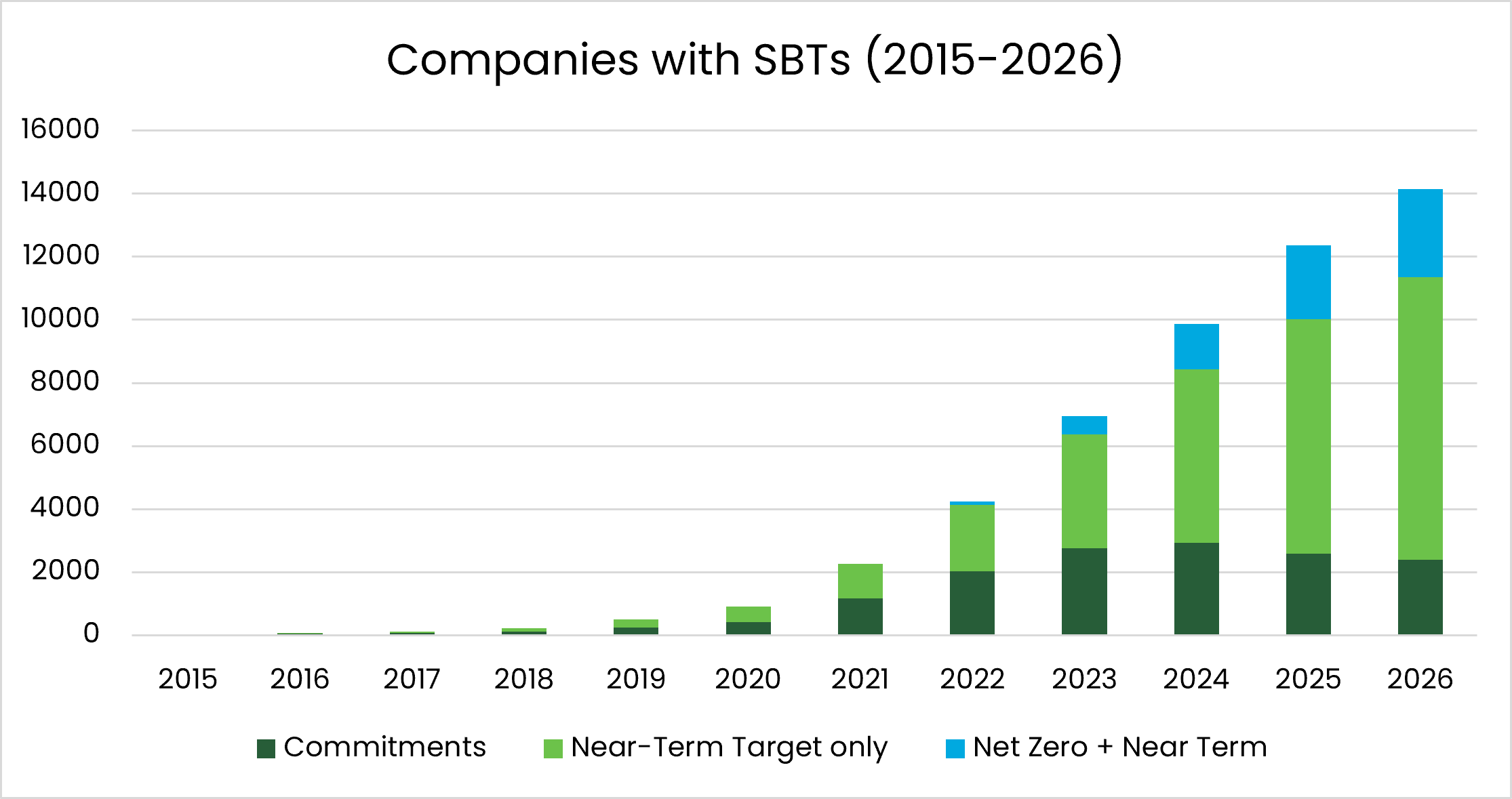
Information source: SBTI Trend Tracker updated September 2026
Why is the launch of the new net-zero standard an important milestone?
The release of V2.0 was built on a comprehensive revision process spanning two years, multiple public consultations, and extensive stakeholder involvement.
Historically, SBTi’s frameworks have focused primarily on how companies set climate science-aligned targets, with limited requirements beyond target validation. V2.0 changes that. The new standard extends into implementation, governance, progress tracking, and disclosure.
It remains to be seen how this substantial shift will affect participation in this voluntary program. The new standard could encourage adoption by providing a clearer roadmap to implementation; on the other hand, additional requirements could represent a barrier for companies considering setting a target.
What are the key changes in V2.0?
As part of transitioning from a “how-to guide” for target-setting in V1.3.1 to a more comprehensive framework for managing the target lifecycle, V2.0 introduces new requirements that will meaningfully change how companies engage with SBTi and manage their climate ambitions.
More details will be covered in Part II, but key highlights include:
Shorter timeframes: Under V2.0, all near-term targets are for a duration of 5 years, and the target base year is required to use the most recent data year available.
Revised target scopes: SBTi has separated each emissions scope, with separate targets required for Scopes 1, 2, and 3; combined targets are no longer allowed. This is an important evolution, particularly for Scope 1 and 2 reduction pathways.
Transition plans: In addition to developing targets, companies must develop (and for some, publicly disclose) a transition plan detailing how they plan to reach net zero.
Target management: SBTi has instituted an assurance framework to manage and monitor targets, including a new end-of-cycle assessment to evaluate how a company has performed against its target(s).
Data assurance: SBTi has introduced third-party data assurance requirements for the first time, with limited assurance required for a company’s base year and target year GHG data.
Market instruments: SBTi now recognizes broader ‘activity-pool’ or sector-level actions that drive decarbonization outside of a single value chain, including some instruments such as commodity certificates. This creates new flexibility and opportunities for many companies; we’ll expand on this subject in Part III.
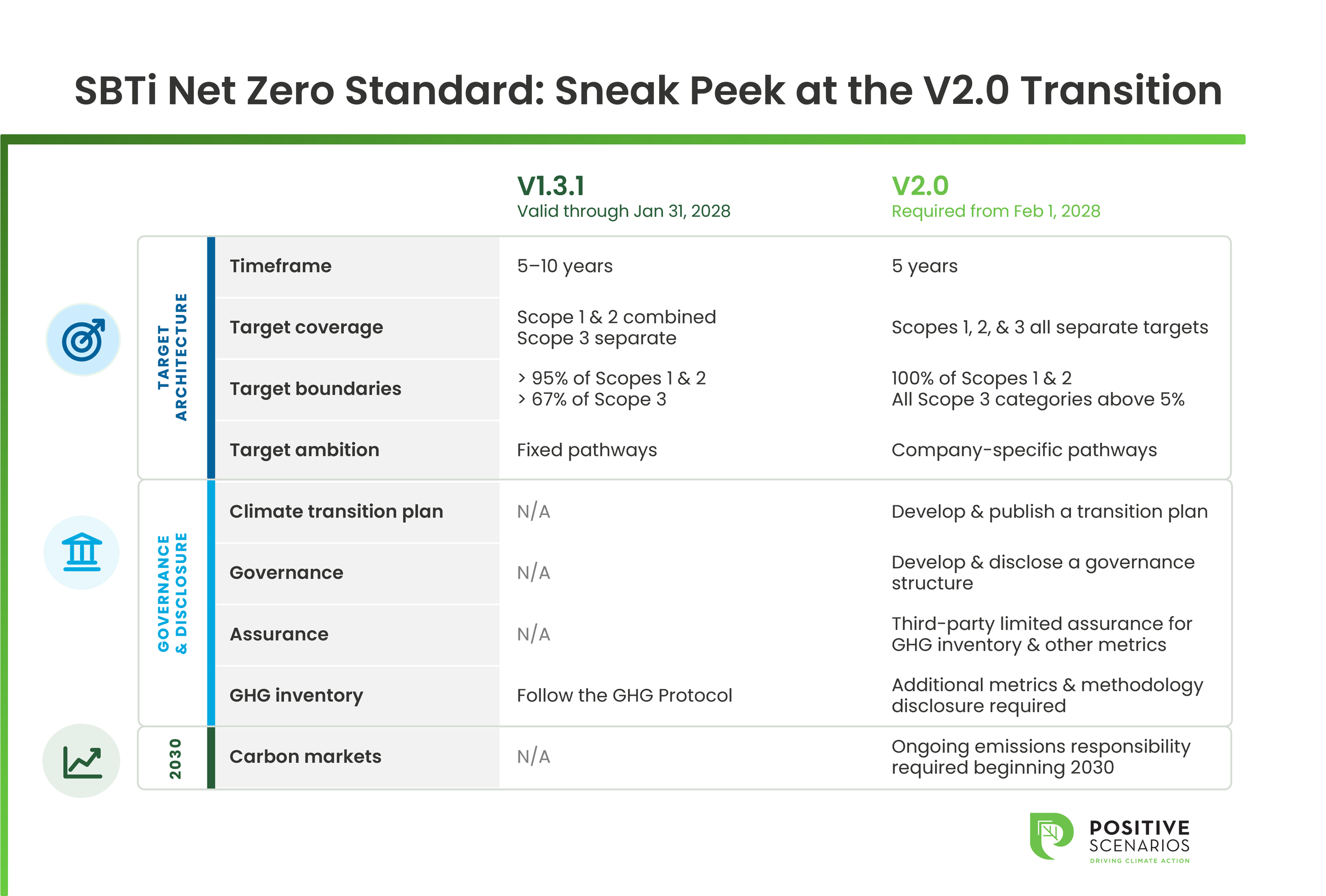
SBTi's Net Zero Standard V2.0 introduces key changes for companies looking to set science-based targets.
When does V2.0 go into effect?
SBTi has instituted an 18-month transition period for new target submissions to adhere to the new version. V2.0 goes into effect February 1, 2027 – meaning it is then available for companies to use – but is not required until February 1, 2028.
However, to submit targets using V1.3.1 during the interim period in 2027, companies must register their commitment to SBTi before February 1, 2027.
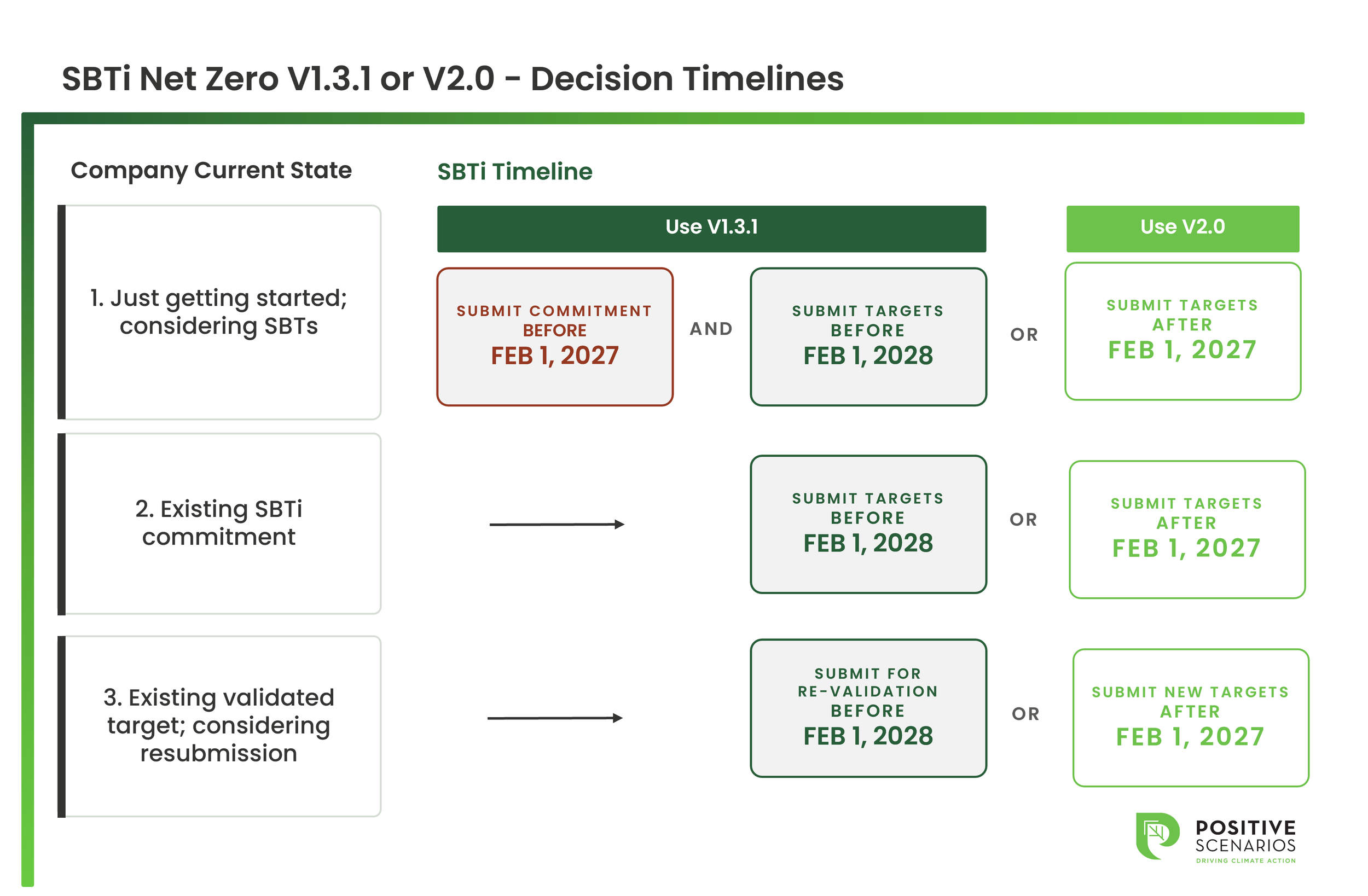
Companies looking to set new science-based targets will have the choice between V1.3.1 and V2.0 of the standard, but must act before February 2027.
What does the launch of V2.0 mean for companies that…
Are submitting or updating SBTs in 2026-2028: Companies submitting targets in 2027 and 2028 will be required to adhere to V2.0 based on the commitment and submission timelines shown in the table above. Companies that wish to submit targets in 2027 under the current standard version must register their commitment with SBTi by January 31, 2027 to maintain their eligibility for V1.3.1.
Note: Companies that are updating existing targets in 2027-2028 should plan their submission timing carefully according to the standard version they wish to apply.
Have existing SBTs: Companies with SBTi-validated science-based targets do not need to transition to the new standard immediately on the effective date. Currently, all SBTs are subject to a 5-year review cycle, during which companies must assess their target(s) and ensure conformance with the current SBTi requirements. Companies with validated targets that undergo their 5-year review after the V2.0 required date of February 1, 2028 will be required to transition to V2.0 at that time.
Note: Companies may choose to initiate their 5-year review early, if they wish to develop their next round of targets using V1.3in 2027.
Plan to submit SBTs in 2028 or beyond: All companies submitting SBTs after February 1, 2028 will follow the new version of the net-zero standard. Some companies considering SBTi submission may benefit from submitting earlier than planned to use the current V1.3.1 while still eligible.
Which standard should my company choose?
Regardless of your current status — whether you are considering setting targets or already have validated targets — you should understand the differences between V1.3.1 and V2.0, communicate these implications to your teams and your leadership, and determine which standard is best suited to your company’s priorities, timeline, and readiness.
Some organizations may choose to accelerate their SBTi timeline to submit under V1.3.1 while still eligible; others may choose to wait and prepare for the expanded requirements of V2.0. The right path for your organization depends on your current target status, submission timeline, budget, resourcing and readiness to meet V2.0’s expanded requirements.
Regardless of which standard you choose, note that two key changes introduced via V2.0 take immediate effect for V1.3.1:
Absolute target pathway: SBTi integrated an updated target-setting method for absolute targets into V1.3.1, to enable a smoother transition to V2.0. Target ambition is defined using the new ‘Dynamic Linear Annual Reduction Rate’, or dLARR method, which will be consistent between the versions.
Market instruments: SBTi now recognizes certain market instruments as eligible to count towards target progress, to bring greater flexibility and opportunities for companies. Part III will explore this in more detail.
If you aren’t sure where to begin, PSC’s SBTi Certified Experts can help you navigate next steps. Contact us for more information.
AI disclaimer: Our team may use AI to edit content for clarity and accuracy. All words and insights are generated by real humans.